
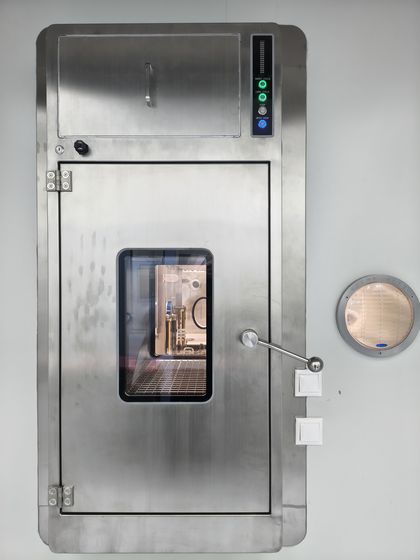
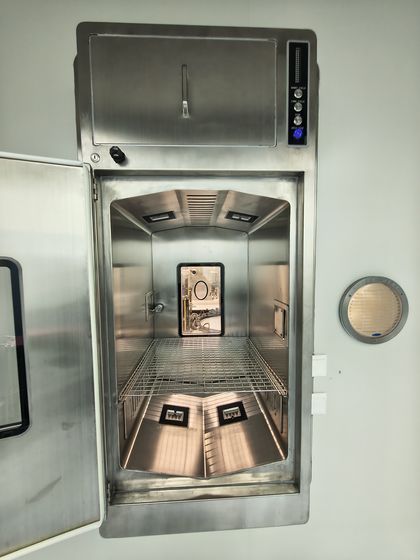
A UV pass box does one thing: it delivers a dose of ultraviolet to the surfaces its light can reach. The word that matters is reach. Light travels in straight lines, and a surface that faces away from every lamp — or is pressed against a shelf — receives nothing at all. Not a smaller dose. None.
Where UV disinfection stops
In a conventional hatch the load sits on a solid shelf. Lamps in the ceiling and the side walls treat the top and the sides. The underside — the face in contact with the shelf, and the face most likely to have touched a trolley, a bench or a glove — is in shadow for the whole cycle. The usual answers are a second cycle with the item turned over, a wipe-down before or after, or an assumption.
Far-UVC changes nothing about this. Filtered 222 nm light is what lets the same technology run in occupied rooms; inside a closed box it is simply a germicidal wavelength that, like every other, stops at the first shadow.
Tackling the underside shadow
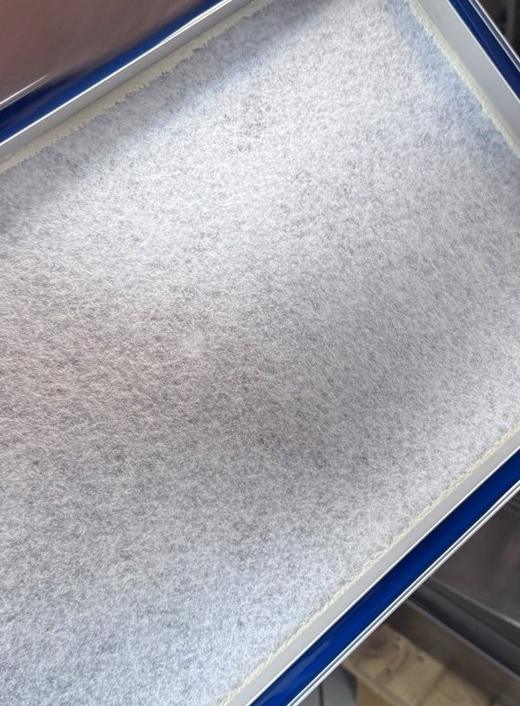
Two filtered Ushio Care222® modules sit above the load, aimed down at the shelf. Two more sit below it, set into the floor of the chamber behind quartz glass and aimed up. The load rests on an open stainless-steel wire grid instead of a solid shelf, so the light reaches the top and the underside in the same cycle, with nobody turning anything over.
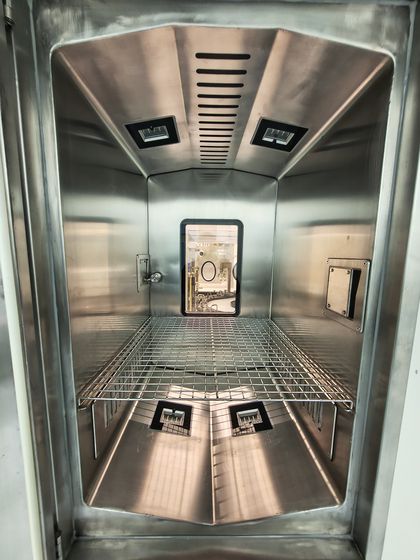
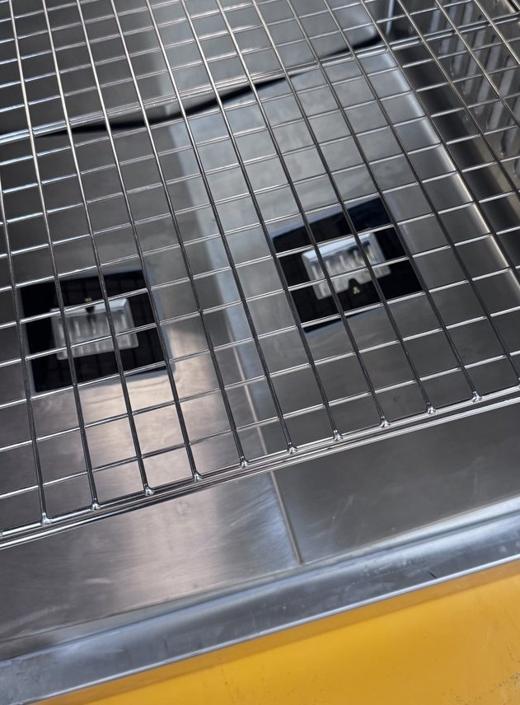
Two simple rules: spread items on the grid and don’t stack them, and leave space between them so the light reaches every side. To our knowledge, nobody had put far-UVC modules under the load in a pass-through box before.
Airflow + Far-UVC
A pass-through box has more to clean than the surfaces of the load: there is also the air inside the chamber. A fan draws the chamber air through activated carbon, which mainly takes out ozone, and a HEPA filter, which holds the particles, and returns it filtered. The air recirculates inside the closed chamber while the lamps treat the surfaces.
Pressure monitoring
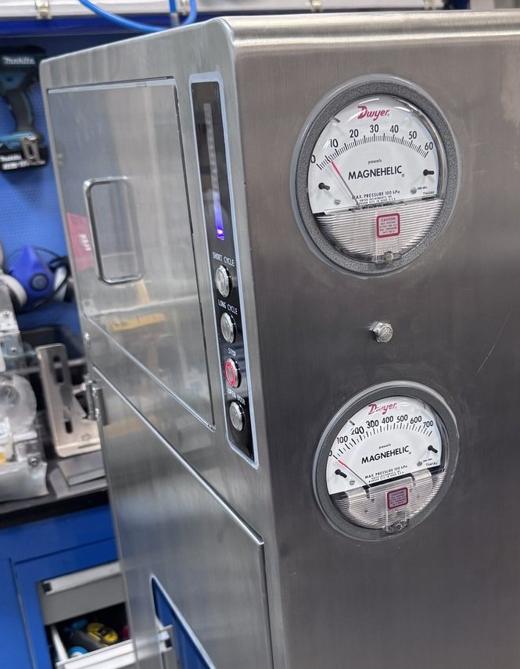
Two Magnehelic® differential-pressure gauges are read from outside, without opening anything. One, 0–60 Pa, shows the chamber pressure against the loading room. The other, 0–750 Pa, shows the pressure drop across the filters — how loaded they are.
Safe transfer
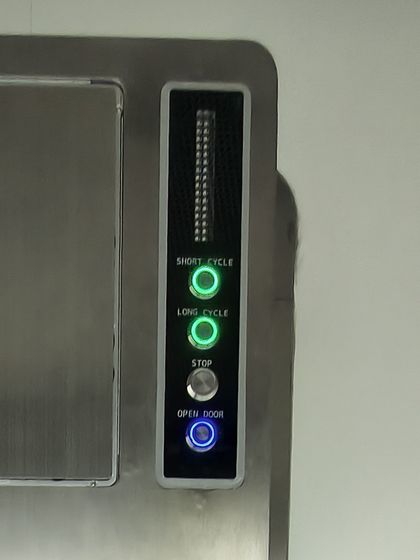
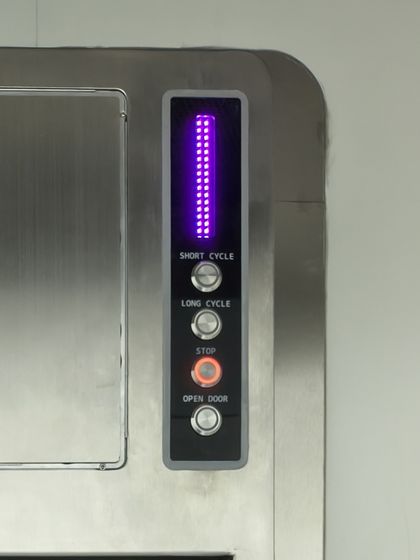
The control panel has four buttons — short cycle, long cycle, stop, open door — and a bar that counts down the time left. The doors are interlocked: the loading door closes and locks before the cycle starts, and the receiving door, on the cleaner side, opens only when the cycle ends. The two doors never open at the same time, and the lamps run only behind locked doors.
Fast, effective decontamination
Load, close, one button. A short or a long cycle, chosen at the control panel. The four modules deliver an average of about 50 µW/cm² across the shelf (UV Medico operating data for this configuration), to the top and the underside of the load at once.
Far-UVC at 222 nm acts against viruses, bacteria, fungi and bacterial spores, and according to UV Medico it does not damage sensitive materials. Used alongside your validated cleaning procedures, it lets you reduce sporicidal solutions: fewer disinfectants, and milder ones. It complements those procedures; it does not replace them.
Where it sits in Annex 1
EU GMP Annex 1 (2022), §4.10
Annex 1 asks for the transfer of materials into Grade A or B to be unidirectional and, where items cannot be sterilised on the way in, for a validated transfer disinfection process instead (§4.11). Airlocks are to provide physical separation and to minimise microbial and particle contamination (§4.12). All of it sits inside a documented contamination control strategy (§2.3).
A far-UVC pass-through box is an engineering control inside that strategy: a fixed dose, delivered the same way every time, at a point where the alternative depends on a person, a wipe and a clock. It does not replace the strategy and it does not set the acceptance criteria. Your QA does that. What the box gives them is something repeatable to qualify.
Why it changes every new pass box
Specifying a pass box has usually meant choosing a size, a lamp count and a cycle time. The lower lamp pair puts a question in front of all three: which faces of the load does the light actually reach? A solid shelf answers it for you — every item arrives with one face untreated. An open grid with lamps beneath it removes the shadow instead of working around it, which is why every Pass-Through Box we deliver now works this way.
How to get one
The design is not tied to one wall. It is sized to the opening, the grades on either side of it and the loads that pass through. If your plant moves instruments, components or small equipment through a hatch and a wipe, send us the wall — its opening, the grades on each side, what goes through and how often. We will come back with a drawing and a dose per face, not a brochure.